
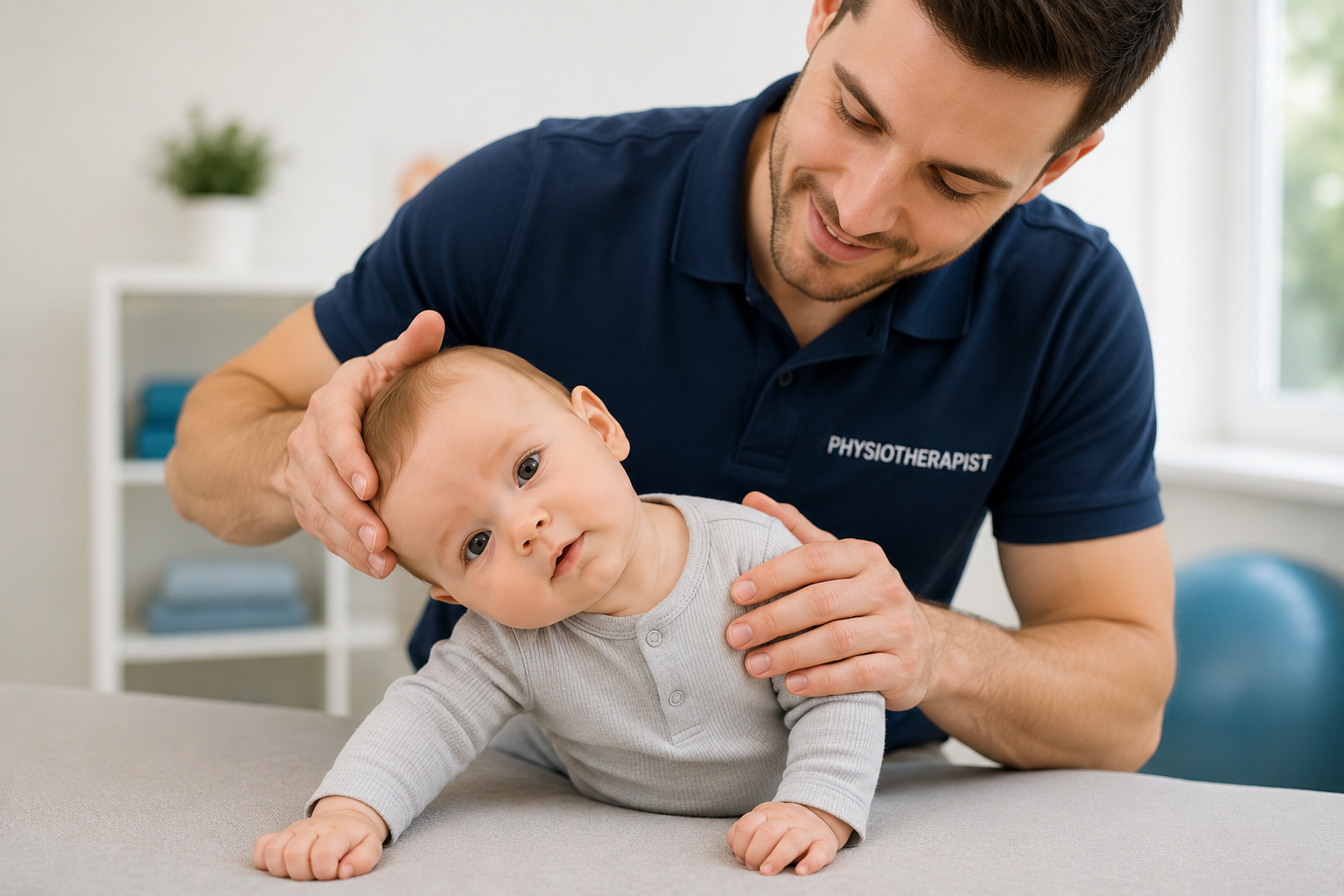
Torticollis in Babies: Signs, Causes, and How Physiotherapy Helps
Noticed your baby tilting their head to one side? Learn about torticollis in infants — its causes, signs, and how mobile paediatric physiotherapy in Sydney can gently improve neck movement and head positioning.
What Is Torticollis?
Torticollis — sometimes called “wry neck” — is a condition where a baby or young child holds their head tilted to one side, often with the chin rotated toward the opposite shoulder. In infants, the most common form is Congenital Muscular Torticollis (CMT), which involves tightening of the sternocleidomastoid (SCM) muscle on one side of the neck.
As mobile paediatric physiotherapists servicing families across Sydney, torticollis is one of the most common conditions we treat in infants — and with early physiotherapy, the outcomes are excellent.
What Does Torticollis Look Like?
Parents often notice that their baby:
- Tilts their head toward one shoulder (toward the tight muscle)
- Rotates their chin away from the same side
- Prefers to look in one direction and resists turning to the other
- Has a tight or rope-like band in the side of the neck (sometimes felt as a small lump in the SCM muscle)
- Develops flat spots on the head (plagiocephaly) due to consistently lying on one side
- Has asymmetric facial features over time if left untreated
These signs are often first noticed in the first few weeks of life, though they may become more obvious as the baby grows.
What Causes Torticollis in Infants?
Congenital Muscular Torticollis (CMT)
The most common form. CMT typically results from limited space in the womb during pregnancy, or from difficult deliveries (particularly forceps or vacuum-assisted births). The SCM muscle on one side becomes shortened or fibrotic, restricting neck movement.
Research confirms that torticollis is often associated with brachial plexus birth palsy (nerve injury at birth), and frequently co-occurs with positional plagiocephaly (head flattening), since a baby who always turns their head one way will develop asymmetric head shape over time.
Positional Torticollis
Develops after birth due to habitual head positioning — for example, always feeding from the same side or lying in one position.
Other Causes
Less commonly, torticollis may be related to visual problems (causing a compensatory head tilt), cervical spine abnormalities such as Klippel-Feil syndrome, or other neurological conditions. A thorough assessment helps rule these out.
Why Early Treatment Matters
Untreated torticollis does not simply resolve on its own in many cases — and the longer it persists, the harder it becomes to address. Left untreated, CMT can lead to:
- Persistent head asymmetry and facial asymmetry
- Significant plagiocephaly (head flattening)
- Delayed motor development — babies who can’t turn their heads freely often have difficulty with rolling, tummy time, and sitting
- Muscle contracture — the tighter the SCM becomes, the more restricted movement becomes
Research from The Royal Children’s Hospital Melbourne confirms that torticollis is a primary risk factor for positional plagiocephaly — making early physiotherapy intervention important for both conditions simultaneously.
How Is Torticollis Treated with Physiotherapy?
Our mobile physiotherapy sessions are tailored specifically to your baby’s age and severity of torticollis. Treatment is gentle, play-based, and family-centred — you’ll be an active participant throughout.
Stretching and Manual Therapy
Gentle, targeted stretching of the SCM and surrounding neck muscles to improve range of motion. This is performed with care and sensitivity to ensure your baby is comfortable.
Strengthening
Encouraging your baby to actively turn and lift their head in both directions helps build balanced muscle strength. We incorporate these movements into tummy time and interactive play.
Handling and Positioning Advice
A huge part of physiotherapy for torticollis is coaching parents and carers on how to carry, feed, play with, and position their baby to encourage movement to the restricted side throughout the day.
Environmental Modifications
Simple changes to your baby’s environment — such as repositioning the cot, changing the direction toys are placed, or adjusting feeding positions — can significantly increase the number of times per day your baby turns toward their restricted side.
Tummy Time Strategies
Tummy time is essential for babies with torticollis. We provide specific strategies to make tummy time safe, comfortable, and effective — even for babies who initially resist it.
When Should I Seek Help?
The earlier, the better. We recommend an assessment if:
- Your baby consistently tilts or rotates their head to one side
- You notice resistance when turning their head to one side during nappy changes or feeding
- There is a lump or tightness in the side of the neck
- Your baby is developing a flat spot on one side of the head
- Your maternal and child health nurse or GP has raised concerns
Physiotherapy initiated in the first few months of life tends to produce the fastest and most complete resolution.
Mobile Baby Physiotherapy Across Sydney
We provide home visits across Sydney, meaning your baby is assessed and treated in a familiar, calm setting. This leads to better relaxation, more cooperative assessment, and more effective treatment. No car trips to a clinic — we come to you.
Frequently Asked Questions
At what age can I start physiotherapy for my baby’s torticollis? As early as possible — ideally within the first 1–3 months. Physiotherapy is safe and effective even for newborns.
How many sessions will my baby need? This depends on the severity. Mild cases may resolve in 4–6 sessions with a good home program. More significant tightness may require longer treatment. We’ll give you a realistic expectation at the first visit.
Can I do the stretches at home? Yes — and you’ll be expected to! We teach parents to perform the key stretches and exercises at home between sessions, which is central to a good outcome. Daily repetition is essential.
Is there a lump in my baby’s neck — is that serious? A small, firm lump in the SCM muscle is a common finding in CMT and represents scar-like tissue within the muscle. It is not dangerous and typically resolves with physiotherapy over time.
Will my baby need a helmet if they have torticollis and a flat head? Not necessarily. When torticollis is treated early and head flattening is mild to moderate, repositioning strategies and physiotherapy are often sufficient. Helmet therapy is reserved for severe cases that don’t respond to conservative management.
Book a Sydney Home Visit
If you’ve noticed your baby favouring one side or holding their head at an angle, don’t wait. Our mobile paediatric physiotherapists are experienced with infant torticollis and will provide gentle, effective treatment in the comfort of your home.
📞 Call us or book online for a home visit anywhere across Sydney.
Gentle care for little necks — right at home